
Before you read: Take our 2-minute self-assessment to see how sponsor-ready you are right now. Then come back to this article to understand what your results mean and how to build momentum from here.
There comes a point in most careers when you realize you don’t want to stay exactly where you are. You’re ready for more growth, more visibility, or a different kind of challenge. Maybe you don’t want to be in this same role a year from now.
Which is fair. Ambitious, even.
But if your plan for getting there involves aggressively refreshing LinkedIn or setting alerts on Indeed, I want to gently suggest a different approach. One that’s far more effective and far less soul-sucking.
Instead of spending your energy trying to find a new job or a mythical sponsor who will magically open doors, what if your goal was to be sponsor-ready?
Because here’s the thing. I don’t actually believe you go out and find a sponsor the way you find a job posting. Sponsors find you. They notice you. They make sure your work is part of the conversation. And they do that because they already know what you’re good at, where you’re headed, and why putting their name behind yours is a smart move.
Our Forté research reflects this. Among our MBA alumni professional population, when we ask what they believe is holding them back from stepping into leadership roles, sponsorship consistently rises to the top. More than confidence and more than competence, it’s visibility and advocacy.

Instead of spending your energy trying to find a new job or a mythical sponsor who will magically open doors, what if your goal was to be sponsor-ready?”
Here’s the Part Most People Get Wrong
Most of us don’t have one omnipresent, career-defining sponsor who swoops in and changes everything with a single comment or job offer. Yes, those stories exist. They usually come with a very good publicist. But for most of us, sponsorship is cumulative.
It’s the person who recommends you for a stretch assignment.
The person who forwards your name to a hiring manager.
The person who reposts something you shared and suddenly a new audience is paying attention.
The person who says, “You should be in this room,” and makes it happen.
Sponsorship isn’t magic. It’s momentum.
So how do you build it?
I like to think of it as getting sponsor-ready. Here are four steps that make that possible.
Step 1: Understand What Sponsorship Actually Is (and What It Isn’t)
Before you can build sponsorship, it helps to stop confusing it with mentorship or coaching.
The three can overlap, but they’re not the same. Mentorship often centers on advice. Coaching focuses on development. Sponsorship is about action. Sponsors use their credibility, influence, and networks to put your name forward when decisions are being made and opportunities are taking shape.
They don’t just help you think through your next moves. They help make them possible.
This matters because sponsorship isn’t a role you ask someone to take on. It’s a behavior they choose.
If you want a deeper look at the different roles sponsors can play and how sponsorship works when it’s done well, Dr. Herminia Ibarra breaks it down beautifully in How to Do Sponsorship Right.
Step 1 isn’t about chasing powerful people. It’s about understanding the actions that create momentum and positioning yourself so those actions are easy to take on your behalf.
Sponsors use their credibility, influence, and networks to put your name forward when decisions are being made and opportunities are taking shape.”
Step 2: Analyze Your Network (Before You Try to Build a New One)
Your network is probably better than you think.
Most people already know others who trust their work, believe they’re capable of more, and will tell them when it’s time to push themselves. Some of those people also happen to be well-connected and regularly in the rooms where decisions get made.
The question isn’t just, “Who do I know?” It’s, “Who am I being intentional with?”
Take stock of who’s already in your circle and what role they play today. Then ask the more useful question: What role could this person play?
If you want a smart, practical way to think about this, Dr. Rosalind Chow’s The Doors You Can Open offers a clear framework for understanding influence and how opportunities actually move through networks.
The goal here isn’t to collect contacts. It’s to strengthen the right relationships so people understand your strengths, know where you want to go, and are willing to speak up when it matters.
That’s how sponsorship starts to take shape.
Step 3: Look Down the Hall Before You Look Out the Window
When people think about their next role, their first instinct is often to look outside their organization.
That makes sense. New role, new title, new company.
But some of the most interesting and career-accelerating opportunities aren’t across town or across industries. They’re down the hall.
How often do you hear, “I love the people I work with, I just don’t love what I’m doing”? That’s usually a signal to look around, not to leave.
Pay attention to what other teams are working on and where skills are in demand. Get curious about projects that stretch you, even if they’re not part of your job description.
Stretch assignments and cross-functional work are fast ways to build visibility and credibility. They let more people see how you think, how you operate, and what you’re capable of.
And that matters. It’s much easier for someone to advocate for you when they’ve seen how your strengths travel beyond your current role.
If you want to be sponsor-ready, don’t just ask, “What’s my next job?” Ask, “Where can I contribute more right now?”
Opportunity notices people who do.
It’s much easier for someone to advocate for you when they’ve seen how your strengths travel beyond your current role.”
Step 4: Be Clear About What You Want (and Say It Out Loud)
Yes, it would be great if the sponsor fairy showed up and told you exactly what your next role should be, perfectly aligned with your skills, values, and lifestyle. But last I checked, they were busy.
You don’t need a perfectly mapped-out career plan. You do need enough clarity to say where you’re headed, what kind of work you want more exposure to, and how others could help.
That means being able to articulate your strengths, your interests, and the kinds of opportunities you want to be considered for. Not as a demand. As information.
When people know what you’re aiming for, it becomes much easier for them to connect dots on your behalf, suggest you for opportunities, or say your name when it matters.
If being sponsor-ready is the goal, clarity isn’t optional. It’s what makes advocacy possible.
It’s not about waiting for someone powerful to change your trajectory. It’s about building enough momentum that advocacy becomes the obvious next step.”
You don’t need to find a sponsor to move forward in your career. You need to be doing work that’s visible, valued, and understood by the right people.
That’s what being sponsor-ready really means. It’s not about waiting for someone powerful to change your trajectory. It’s about building enough momentum that advocacy becomes the obvious next step.
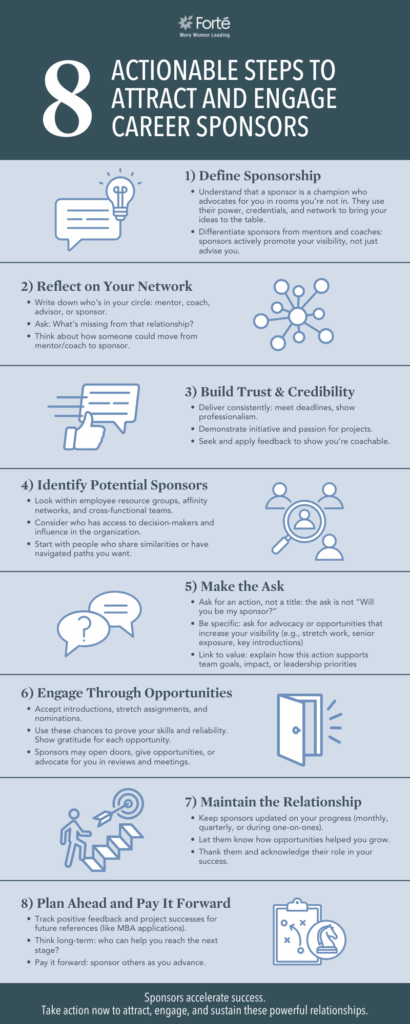
If that feels like a lot, start small. We’ve created a quick guide to help you see where a little intentional effort could go a long way.