
FOR IMMEDIATE RELEASE
Business school increasingly helps prepare MBAs to address gender inequality at work -- MBAs and their employers also take action
Austin, TX/April 2, 2019 – Does an MBA degree eliminate gender inequality – such as the pay gap – when graduates return to the workplace? Unfortunately, no, but both MBAs and their employers are taking steps to address gender inequality at work, and business school increasingly helps prepare graduates to tackle these issues. These combined efforts appear to be having a positive impact on reducing gender inequality at work, according to new research from Forté Foundation. The online survey of 900 male and female MBA alumni who graduated between 2005-2017, was conducted by Forté and led by Michelle Wieser, Ph.D., Interim Dean, School of Business, St. Catherine University. The research is the second in a series. Forté released research early this year that explored whether an MBA holds the key to help women and minorities increase earning power and equality in the workplace -- including the impact on the pay gap. “This new research sheds light on whether we’re seeing improvements in workplace gender equality for MBAs, what issues impact women and men the most, and how business school helps to prepare alumni to address,” said Elissa Sangster, CEO, Forté Foundation. “We found that while gender inequality in the workplace is still pervasive, we may be starting to see improvements in MBA’s personal experiences from their past to current employer. And recent MBA graduates are more likely to say than earlier alumni that the degree helped prepare them to tackle these issues in the workplace.” Following are key findings from the second series of Forte’s MBA research: Workplace Gender Equality?- Have women and men achieved gender equality in the workplace? It depends on who you ask.
Overall, more than three-fourths of MBA respondents (76%) believe gender equality has not been
achieved in the workplace. There is a significant difference by gender.
- More than eight in 10 female MBAs (82%) believe gender equality has not been achieved and this is even higher for minority women (87%).
- Only six in 10 male MBAs (63%) agree that gender equality has not been achieved. Personal Experience with Gender Inequality
- Nearly six in 10 MBAs (59%) said they have “personally experienced” or “heard of” gender inequality at “one or more past organizations”. This narrows to 4 in 10 (46%) who have “personally experienced” or “heard of” gender inequality within their “current organization”.
- One third of MBA respondents (33%) said they “personally experienced” gender inequality at a past employer versus less than a quarter (18%) in their current role, and 38% had “heard of” gender inequality in a past job compared with 28% in their present position.
- Of those who have “personally experienced” gender inequality at a past job, 44% were women and 15% were men. This narrows to 24% for women and 8% for men in their current role.
- Of those who “heard of” gender inequality in a past post, 39% were women and 45% were men. This narrows in their current role and there is no difference gender (30% women, 29% men).
- The top three types of gender inequality female MBAs “personally experienced” in rank order are: unequal opportunities for promotions or career advancement, hostile work environment, and unequal career opportunities (global assignments, special projects, etc.).
- The top three types of gender inequality male MBAs have “personally experienced” are: gender preference in recruiting and hiring practices, hostile work environment, lack of or inadequate parental leave policies.
- The top three types of gender inequality female and male MBA respondents have “heard of” are: hostile work environment, unequal access to training or educational opportunities, unequal opportunities for promotions or career advancement.
 Actions to Address Workplace Gender Inequality
- About 4 in 10 (38%) MBA graduates believe their organizations are working to address gender inequality in the workplace – close to half are men (47%) and just one third are women (33%).
- How are organizations tackling gender inequality? MBAs surveyed believe these are the actions their employer is taking, ranked from highest to lowest:
- Formed a group or task force to address the issues
- Establishing safe reporting mechanisms
- Made changes to employment policies
- Instituted new training on gender inequality
- Incorporated measures around gender equality into performance expectations
- At a personal level, one third of MBA respondents (30%) say that they individually have taken action to address gender inequality at their organization – a relatively equal percentage of men (31%) and women (30%). Actions include (responses ordered from most common to least common actions):
- Speak up/advocate/openly share information
- Work to change organizational structure or policies
- Deliberately focus on gender equality during recruitment, hiring, and promotion decisions
- Actively lead or participate in a women’s affinity group
- Coach or mentor women and men on gender inequality
- Work with HR on gender inequality issues
- Speak to supervisor about issues of inequality
- Speak to senior leadership about issues of inequality
- File official complaints against the company or individual
- Male and female MBAs addressed gender inequality differently within their organizations.
- Women were more likely to actively lead or participate in a women’s affinity group (22%) or speak up and advocate for what they believe in (19%).
- Men were more likely to address gender inequality in their organizations by deliberately focusing on recruiting, hiring, and promoting more women (30%), and “work to change organizational structure or policies” (20%) that impact gender inequality.
- A majority of recent MBA graduates (62% of MBA graduating classes in 2016-2017) believe that business school helps prepare them to address gender inequality in the workplace versus less than half of earlier business school graduates (40% of graduates from 2005-2015).
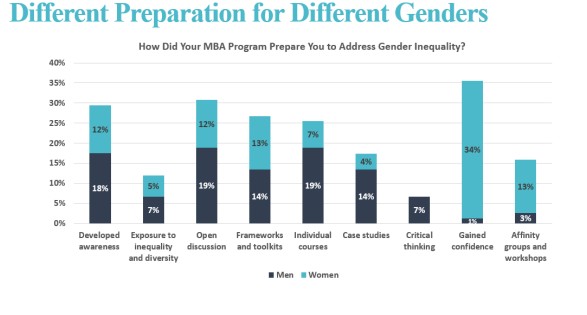
- MBA respondents say business school helps them to address gender inequality in the workplace through a variety of ways such as building awareness and confidence to address issues through: case studies, courses, frameworks and toolkits, affinity groups and workshops, open discussion, and more. Interestingly, men and women report differences in how MBA programs prepared them.
- Men were more likely to cite “developing awareness” (men 18%, women 12%), “individual courses” (19%, 7%) and case studies (14%, 4%) as having the most impact.
- Women were more likely to say they “gained confidence” to address gender inequality in the workplace (women 34%, men 1%) and that “affinity groups and workshops” helped prepare them (women 13%, men 3%).
 METHODOLOGY
The online survey of 900 MBA graduates from the years 2005 through 2017 was conducted in March and April 2018. It was distributed through the Consortium for Graduate Study in Management, Forté Foundation sponsor schools and the Forté Foundation database of alumni. Additional respondent characteristics are included in the full research findings.
FORTÉ SPONSORS
Forté Corporate Sponsors: A.T. Kearney; Accenture; Amazon; American Airlines; AT&T; Bank of America Merrill Lynch; Barclays; Bloomberg; Boston Consulting Group; Capital Group; Cargill; CarVal Investors; Chevron; Cigna; Citi; Cognizant; Credit Suisse; DaVita; Deloitte; Deutsche Bank; The Dow Chemical Company; Eli Lilly and Company; Evercore; ExxonMobil; EY; Goldman Sachs; Google; Greystar; Guggenheim Partners; Hines; IBM Global Business Services; Invesco; JP Morgan; KPMG; Lazard; Liberty Mutual; Macquarie Group; Masco Corporation; McKinsey & Company; MFS Investment Management; Morgan Stanley; MUFG; PIMCO; The PNC Financial Services Group; Prologis; State Street; T-Mobile; Vanguard; Walmart; Wells Fargo Securities; Whirlpool Corporation
Forté Nonprofit Sponsors: 100 Women in Finance; CFA Institute; Graduate Management Admission Council
Forté MBA Sponsors: Alliance Manchester Business School; Arizona State University W.P. Carey School of Business; Babson College (F.W. Olin Graduate School of Business); Carnegie Mellon University (Tepper School of Business); Columbia Business School; Cornell University (Johnson School of Management); Dartmouth College (Tuck School of Business); Duke University (The Fuqua School of Business); Emory University (Goizueta Business School); ESADE Business School; Georgetown University (McDonough School of Business); George Washington University School of Business; Georgia Tech (Scheller College of Business); Harvard Business School; HEC-Paris; IE Business School; IESE Business School; Imperial College Business School; Indiana University - Bloomington (Kelley School of Business); IMD Business School; INSEAD; London Business School; Massachusetts Institute of Technology (Sloan); Michigan State University (Broad College of Business); New York University (Stern School of Business); Northwestern University (Kellogg School of Management); Ohio State University Fisher College of Business; Queen’s School of Business; Rice University Jesse H. Jones Graduate School of Business; Southern Methodist University (Cox School of Business); University of California - Berkeley (Haas School of Business); University of California - Los Angeles (Anderson School of Management); University of Cambridge (Judge Business School); University of Chicago (Booth School of Business); University of Illinois Urbana-Champaign (College of Business); University of Maryland Smith School of Business; University of Michigan (Ross School of Business); University of Minnesota - Twin Cities (Carlson School of Management); University of North Carolina (Kenan-Flagler Business School); University of Notre Dame (Mendoza College of Business); University of Oxford (Saïd Business School); University of Pennsylvania (The Wharton School); University of Rochester (Simon School of Business); University of Southern California (Marshall School of Business); University of Texas at Austin (McCombs School of Business); University of Toronto (Rotman School of Management); University of Virginia (Darden School of Business); University of Washington (Foster School of Business); University of Wisconsin-Madison (Wisconsin School of Business); Vanderbilt University Owen Graduate School of Management; Washington University in St. Louis (Olin Business School); Western University (Ivey School of Management); Yale School of Management; York University (Schulich School of Business)
Universities: Amherst College; Babson University; Barnard College; Bryn Mawr College; Carlow University; Carnegie Mellon University; Case Western Reserve University; Colby College; College of William & Mary; Columbia University; Cornell University; George Washington University; Georgetown University; Howard University; Hunter College, CUNY; Indiana University; Mount Holyoke College; New York University; Pennsylvania State University; Purdue University; Rutgers University; Smith College; Spelman College; Texas A&M; University of Chicago; University of Colorado; University of Iowa; University of Kentucky; University of Maryland; University of Michigan; University of Rochester; University of Southern California (Marshall School of Business); University of Toronto; Vanderbilt University; Vassar College; Washington University of St. Louis; Wheaton College; Yale University
ABOUT FORTÉ Forté is a nonprofit organization with the goal of achieving gender parity at all levels of business. Forté works closely with business schools, corporations, and universities to ensure women have access to opportunities at every stage in their careers. Forté offers a wide variety of resources, including MBA prep, professional development, leadership education, and a diverse community of successful women. For more information, visit fortefoundation.org.
Media contacts: Michele Vana, BCW Global, michele.vana@bcw-global.com; Katie Stanfield, Forté Foundation, katies@fortefoundation.org
Download the PDF
METHODOLOGY
The online survey of 900 MBA graduates from the years 2005 through 2017 was conducted in March and April 2018. It was distributed through the Consortium for Graduate Study in Management, Forté Foundation sponsor schools and the Forté Foundation database of alumni. Additional respondent characteristics are included in the full research findings.
FORTÉ SPONSORS
Forté Corporate Sponsors: A.T. Kearney; Accenture; Amazon; American Airlines; AT&T; Bank of America Merrill Lynch; Barclays; Bloomberg; Boston Consulting Group; Capital Group; Cargill; CarVal Investors; Chevron; Cigna; Citi; Cognizant; Credit Suisse; DaVita; Deloitte; Deutsche Bank; The Dow Chemical Company; Eli Lilly and Company; Evercore; ExxonMobil; EY; Goldman Sachs; Google; Greystar; Guggenheim Partners; Hines; IBM Global Business Services; Invesco; JP Morgan; KPMG; Lazard; Liberty Mutual; Macquarie Group; Masco Corporation; McKinsey & Company; MFS Investment Management; Morgan Stanley; MUFG; PIMCO; The PNC Financial Services Group; Prologis; State Street; T-Mobile; Vanguard; Walmart; Wells Fargo Securities; Whirlpool Corporation
Forté Nonprofit Sponsors: 100 Women in Finance; CFA Institute; Graduate Management Admission Council
Forté MBA Sponsors: Alliance Manchester Business School; Arizona State University W.P. Carey School of Business; Babson College (F.W. Olin Graduate School of Business); Carnegie Mellon University (Tepper School of Business); Columbia Business School; Cornell University (Johnson School of Management); Dartmouth College (Tuck School of Business); Duke University (The Fuqua School of Business); Emory University (Goizueta Business School); ESADE Business School; Georgetown University (McDonough School of Business); George Washington University School of Business; Georgia Tech (Scheller College of Business); Harvard Business School; HEC-Paris; IE Business School; IESE Business School; Imperial College Business School; Indiana University - Bloomington (Kelley School of Business); IMD Business School; INSEAD; London Business School; Massachusetts Institute of Technology (Sloan); Michigan State University (Broad College of Business); New York University (Stern School of Business); Northwestern University (Kellogg School of Management); Ohio State University Fisher College of Business; Queen’s School of Business; Rice University Jesse H. Jones Graduate School of Business; Southern Methodist University (Cox School of Business); University of California - Berkeley (Haas School of Business); University of California - Los Angeles (Anderson School of Management); University of Cambridge (Judge Business School); University of Chicago (Booth School of Business); University of Illinois Urbana-Champaign (College of Business); University of Maryland Smith School of Business; University of Michigan (Ross School of Business); University of Minnesota - Twin Cities (Carlson School of Management); University of North Carolina (Kenan-Flagler Business School); University of Notre Dame (Mendoza College of Business); University of Oxford (Saïd Business School); University of Pennsylvania (The Wharton School); University of Rochester (Simon School of Business); University of Southern California (Marshall School of Business); University of Texas at Austin (McCombs School of Business); University of Toronto (Rotman School of Management); University of Virginia (Darden School of Business); University of Washington (Foster School of Business); University of Wisconsin-Madison (Wisconsin School of Business); Vanderbilt University Owen Graduate School of Management; Washington University in St. Louis (Olin Business School); Western University (Ivey School of Management); Yale School of Management; York University (Schulich School of Business)
Universities: Amherst College; Babson University; Barnard College; Bryn Mawr College; Carlow University; Carnegie Mellon University; Case Western Reserve University; Colby College; College of William & Mary; Columbia University; Cornell University; George Washington University; Georgetown University; Howard University; Hunter College, CUNY; Indiana University; Mount Holyoke College; New York University; Pennsylvania State University; Purdue University; Rutgers University; Smith College; Spelman College; Texas A&M; University of Chicago; University of Colorado; University of Iowa; University of Kentucky; University of Maryland; University of Michigan; University of Rochester; University of Southern California (Marshall School of Business); University of Toronto; Vanderbilt University; Vassar College; Washington University of St. Louis; Wheaton College; Yale University
ABOUT FORTÉ Forté is a nonprofit organization with the goal of achieving gender parity at all levels of business. Forté works closely with business schools, corporations, and universities to ensure women have access to opportunities at every stage in their careers. Forté offers a wide variety of resources, including MBA prep, professional development, leadership education, and a diverse community of successful women. For more information, visit fortefoundation.org.
Media contacts: Michele Vana, BCW Global, michele.vana@bcw-global.com; Katie Stanfield, Forté Foundation, katies@fortefoundation.org
Download the PDF