
FOR IMMEDIATE RELEASE
Demand from businesses and male MBA alumni, sparks corporate initiative creation – which comes at a time when 1 in 4 women consider leaving the workforce or downshifting their career due to Covid-19
(Austin, TX, October 15, 2020) – A grassroots movement that started with the launch of Forté Foundation’s “Men As Allies” gender equity initiative at 10 business school campuses in 2016, and grew to 41 schools in less than three years, is now expanding to corporations.
The launch of the corporate initiative comes at a time when one in four women are considering leaving the workforce or career downshifting, McKinsey and LeanIn.org’s Women in the Workplace study found. In addition, The National Women’s Law Center, found that 80% (865,000) of the 1.1 million workers who left the labor force in September, were women, based on an analysis of Bureau of Labor Statistics data.
The PNC Financial Services Group, Inc., one of the largest financial services firms in the U.S., co-created and piloted a year-long program to help create Forté’s “Men As Allies” corporate initiative. Since its successful launch at PNC, early adopters of the program, including Toronto-Dominion Bank, Webster Bank and Kaiser Permanente recently signed on to start “Men As Allies” pilots at their companies.
To kick off the new initiative, Forté is hosting a Men As Allies Inclusive Leadership Online Program taking place on Mondays and Wednesdays from 12pm-3pm ET from October 19-October 28. During four half- day sessions, Forté executives, along with expert authors and presenters, will share recent research and personal stories to help participants develop a deeper understanding of gender equity in the workplace, what it means to be a male ally, and to create a personal action plan. Speakers include:
- Brad Johnson and Dave Smith, co-authors of the just published Good Guys: How Men can be Better Allies to Women in the Workplace and Athena Rising: How and Why Men Should Mentor Women
- Julie Kratz, speaker, trainer and author of Lead Like An Ally
- Joshua Stewart, Vice President, Director, Talent Programs & Accessibility at PNC
- Ericka Young, President and Founder, Tailor-Made Budgets, who will partner with Kratz to explore the role of intersectionality in gender allyship.
Key drivers behind initiative
“The goal of our Men As Allies program at business schools is to help male students benefit from, and get involved in, enhancing gender equity on campus and to take that experience back to the business world,” says Forté’s CEO Elissa Sangster. “But what we heard from recent MBA graduates is that their company did not have a similar male allyship program. Since there was no forum to put the knowledge they gained from our campus program into practice to foster a more equitable culture at work, we’re helping them to create one. It couldn’t come at a better time with more women opting out of the workforce and contemplating what’s next for their careers in the coronavirus crisis.”
On the corporate front, Forté was also approached by some companies that wanted help to develop a male allyship initiative within their organization. Working with PNC’s talent team, the first company to pilot the program, Forté’s corporate initiative was born. The Forté and PNC team also involved workplace leadership experts David Smith, PhD, and Brad Johnson, PhD, who will speak at the Men As
Allies Inclusive Leadership Online Program on October 19 from 12:15-1:15 pm ET.
Sangster added there were other drivers for creating this corporate initiative beyond growing demand from MBA alumni and companies. “Despite mounds of research over many years that demonstrates the benefits of diversity to the bottom line, there is a groundswell of evidence that corporate progress on women’s advancement is not moving forward,” she said.
In fact, recent Forté research revealed that even women with an MBA don’t advance to the same level as men, and have fewer direct reports and less job satisfaction. Forté’s research also found the gender pay gap post-MBA actually widens. Women earned 3% less, on average, than their male counterparts pre-MBA. The gap increases to 10% in their first post-MBA job, and 28% for current compensation, adjusted for years of experience.
“On the one hand, we’ve seen greater demand for diversity and pay transparency from investors, and even government in some parts of the world, plus CEO-led diversity initiatives,” Sangster said, “but we also need grassroots male ally programs to help move men from the sidelines to the front lines to create a more equitable work environment. Women can’t do it alone.”
PNC pilot program
After a number of months developing the program with Forté, PNC launched the first “Men As Allies” pilot with a group of employees in January 2018. Caitlin McLaughlin, senior vice president with responsibility for talent at PNC and a Forté board member, helped steer the dialogue and identify the program as a ground-breaking effort PNC wanted to champion.
Josh Stewart, PNC’s director of talent programs and accessibility, helped craft elements of the curriculum that encourage men to notice how gender influences both women’s and men’s work experiences. The goal is to increase their comfort to discuss gender issues, develop and refine their gender lens, and enable them to create action plans to make a difference within their individual work settings. Intersectionality also takes center stage in the program as men explore not only gender but its intersections with other dimensions of diversity.
In the first year of implementing its male ally pilot program, Stewart says the outcomes were better than anticipated. Pre- and post-program measures revealed significant increases in all of the program’s measures including participants’ comfort discussing gender equity in the workplace, knowledge of gender equity opportunities and recent actions taken to increase gender inclusion.
“Beyond the core program measurements, success in creating male allies is highly personalized,” Stewart says. “Ally actions that make a difference depend on the ally’s position in the organization, their readiness and the needs in their respective workplace and relationships. One ally may inspect their hiring processes and decisions, another may more confidently agree to mentorship relationship with a woman, another make take a leadership role in the women’s resource group – all critical actions to advancing gender inclusion.”
PNC’s pilot was delivered in three markets in partnership with the firm’s long-established Women’s Employee Business Resource Group, Women Connect. The company plans to expand and enhance the program to accommodate greater numbers of male managers annually.
Why male ally programs are needed
“Men often think they need some sort of grand gesture to support gender equity, like standing up in a high-profile meeting to publicly call out a sexist remark by a colleague. Others think the push for parity needs to come from the top,” said Sangster. “But being a male ally plays out in many different ways.
Subtle, non-confrontational actions that support gender equity can be highly effective, and research shows middle managers, not CEOs, play a crucial role in women’s career retention and advancement.”
Forté Foundation points to data demonstrating the power of male allyship and why companies need women’s networks that include male allies at all levels.
- A company that has an active women’s network and opens it to women and men is among the top factors statistically proven to influence women’s advancement and pay, reveals Accenture research based on a survey of 22,000 working men and women with a university education in 34 countries. But half the women surveyed work for organizations that don’t provide a network.
- A McKinsey and Lean In study found the biggest obstacle women face is their first step up to management -- for every 100 men, only 72 women are promoted and hired to manager, which demonstrates a “broken rung” early in the leadership pipeline.
- Another study from Bain & Company found women’s ambition and confidence plummeted after just two years on the job. Why? They reported a “lack of support by their supervisor for my career ambitions” and “not seeing themselves fitting the [male] stereotype of success.”
“A male ally group can help men understand the power of their daily gestures and impact over those they supervise,” said Sangster. “Being a male ally means learning about what, and what not, to do. And to be frank, both men and women can benefit from those conversations.”
Stages of male allyship
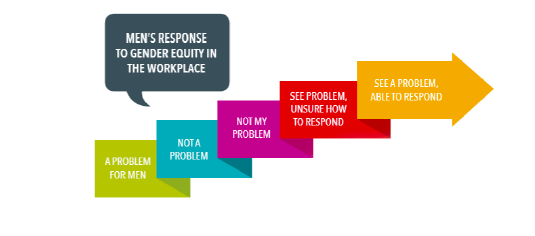
According to Forté, there are varying stages of male allyship and reasons why men don’t get involved in gender equity at work. They view gender equity at work as:
- A problem for men: This group of men view women’s successes as reducing their opportunities and negatively influencing their advancement. They see diversity as a zero-sum game. If one group benefits, the other loses. In their minds, women are receiving special treatment.
- Not a problem: Many men do not see gender diversity as an issue, because they see the women in leadership roles in their organization, in their industry or in the world at large as proof that no problem exists.
- Not my problem: Some men are able to perceive— or are open to believing—that gender does play a role in how women are treated at work. However, they don’t feel as though gender diversity is their problem.
- See a problem, unsure how to respond: As men listen and learn more about how gender can negatively impact women’s career opportunities, they realize gendered-related challenges do affect many women at work. But many men feel confused about what role to play and how to take action.
- See a problem, able to respond: Moving to the highly supportive end of the spectrum, there exists a small percentage of men who are not only conversant regarding gender at work and their reasons for supporting gender equity, but also feel able to respond in some way and make an impact.
Benefits of male ally groups
There are myriad benefits to creating male ally groups, which don’t operate in isolation, but should be woven into the fabric of the company including internal women’s networks. They include:
- Move men from sidelines to the front lines in gender equity – Male ally groups position men as an integral part of diversity and inclusion, rather than as outsiders struggling to understand their place.
- Create a game-changer – Adding men to the mix is a powerful and underused way to strengthen a company’s diversity and inclusion efforts and accelerate gender equity progress.
- Engage men in deeply meaningful ways – They provide a forum for men to get involved, a place to educate themselves, a space to ask the uncomfortable questions, an opportunity to clarify their own thinking, and a means to learn how they can contribute.
- Influence thinking, behavior and action – Male ally groups impact how men think about gender equity, and, crucially, how they behave. Many men report that involvement in a male ally group moves them from thinking to action.
Elements of Forté’s Men As Allies corporate program
The Men As Allies corporate initiative includes three elements:
- Toolkit: A toolkit is available to companies and individuals upon request. It explores what it means to be a male ally at work. Punctuated with examples of allyship in action and overviews of male ally groups in various stages of development, the toolkit offers a roadmap to starting a male ally group. The toolkit introduces Forté’s Ally Empower model and addresses common questions that arise while implementing a program such as “Why start a Male Allies group?” and “Why don’t more men get involved?”
- Curriculum: Forté also developed a nine-part curriculum to help create and enhance male allyship programs. The curriculum encourages men to reflect on gender in the workplace, develop gender acumen and model allyship behaviors. For instance: reaching out to their personal and professional networks to actively recruit more female candidates. The curriculum can be implemented in its entirety or redesigned to respond to individual organization’s needs.
- Access to experts: For companies that need additional help, Forté staff and outside experts, including members of PNC’s team, David Smith and Brad Johnson, can help lead the curriculum.