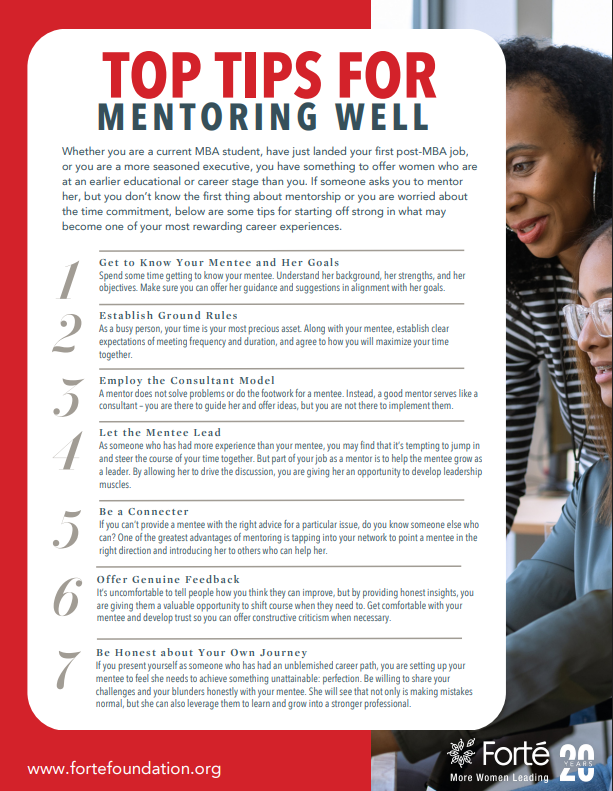

When people hear the word “mentor,” they sometimes imagine they are signing up to become a combination career coach, therapist, recruiter, life strategist, and magical problem-solving wizard. Exhausting, right?
Good news: that isn’t actually the job. A good mentor doesn’t need to have all the answers.
You don’t need to know exactly what someone should do with her career, who she should marry, whether she should leave consulting, or if she should go back to school.
Your job is simpler than that. Your job is to help someone think.

One of the best things a mentor can do is help someone translate what she’s already doing into the kind of language that makes other people understand her value.”
That’s what makes mentoring so powerful. A great mentor helps someone see herself more clearly. She asks good questions. She points out strengths the mentee may not see. She helps connect the dots between what the mentee has done and what employers, managers, and schools are actually looking for.
Because a lot of people are walking around with valuable skills they don't know how to talk about.
One of the best things a mentor can do is help someone translate what she’s already doing into the kind of language that makes other people understand her value.
The best mentors don’t only give advice. They listen. They help mentees make sense of what they’re good at, where they want to go, and what might be getting in the way.
But they also know where the line is.
As a mentor, you aren’t there to solve every problem, rewrite every resume, or spend six hours editing a cover letter line by line while silently wondering how this became your entire Saturday.
the mentors who are most helpful are usually the ones who are willing to admit that they made mistakes, changed their minds, took the wrong job, stayed too long, spoke up too late, or had absolutely no idea what they were doing at 28.”
You’re there to guide. To ask questions. To share what you have learned. To say, “Here’s what I would be paying attention to if I were you.” And often, to say, “You should really talk to this person because she knows a lot more about this area than I do.”
That last part matters. A lot. One of the greatest gifts you can give a mentee is access to your network. Not in a weird transactional way. In a “you should know each other because I think you would really hit it off” kind of way.
Mentoring is not about being perfect. In fact, the mentors who are most helpful are usually the ones who are willing to admit that they made mistakes, changed their minds, took the wrong job, stayed too long, spoke up too late, or had absolutely no idea what they were doing at 28.
That’s the good stuff. Because at the end of the day, one of the best things a mentor can do is offer proof that the mentee isn’t the only one figuring it out as they go.
For more practical mentoring tips, check out Forté’s Top Tips for Mentoring Well guide.