
Recently, we had the absolute pleasure of hosting Dr. Kate Mason for a Forté Business Essentials session, and let me just say…WOW! I’ve been doing this work for a while (read: I’m a seasoned professional), and I still walked away with a fresh perspective, tools I could actually use, and more than one moment of “I wish I had this 10 years ago.”

I wish I had this 10 years ago.
If you’ve ever wrestled with the tension between being powerful and being likeable at work, this conversation was for you. Kate’s new book, Powerfully Likeable, explores how we can lead with both influence and authenticity, without sacrificing one for the other. And in the workshop, she didn’t just talk about it; she gave us three powerful exercises to actually work through it.
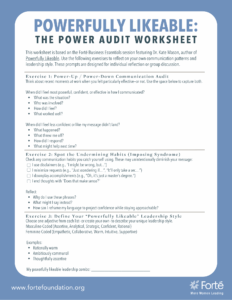
Exercise 1: The Personal Power Audit
What lights you up? What shuts you down?
Kate asked us to reflect on moments when we felt truly effective and confident in our communication. She calls these your “power-up” moments. Then, she had us do the flip side - those times when we felt smaller, silenced, or just “off.” These “power-down” moments are just as important to recognize.
Why it matters: This isn’t about fixing yourself. It’s about noticing patterns and understanding what environments help you shine and when you might need to adjust, advocate, or prepare differently.
It’s about noticing patterns and understanding what environments help you shine and when you might need to adjust, advocate, or prepare differently.
Try it: Download the Power Audit Worksheet to start capturing your personal “power-up” and “power-down” moments.
Exercise 2: Spot the Underminers (a.k.a. Imposing Syndrome)
Are you accidentally shrinking your message?
Kate introduced a term I loved - Imposing Syndrome. No, this isn’t Imposter Syndrome with a typo. It’s that sneaky fear that asking for time, space, or credit will make us “too much.” She outlined four behaviors to watch for:
- The Disclaimer: “I might be wrong, but…”
- The Minimizer: “It’ll just take a second…”
- The Downplayer: “Oh, it’s just a master’s degree…”
- The Accidental Underminer: “Does that make sense?”
Guilty? Me too. Kate reminded us that these habits are often well-intentioned but they chip away at our credibility.
Try it: This Power Audit Worksheet Checklist helps you recognize patterns in your own language and experiment with more direct, confident alternatives.
Exercise 3: Name Your Leadership Style
Two adjectives. One authentic you.
This final exercise was deceptively simple and incredibly powerful. Kate gave us two columns of leadership traits - traditionally “masculine-coded” (e.g., assertive, analytical) and “feminine-coded” (e.g., empathetic, collaborative). She then asked us to combine one from each list to describe our own leadership persona.
The goal? To help you own your leadership in a way that feels like you, not a watered-down version of someone else.
Examples people shared:
- Rationally warm
- Ambitiously communal
- Thoughtfully assertive
Try it: Use the Power Audit Worksheet to explore your own “powerfully likeable” combination.
Final Thoughts: Add This Book to Your Gift List
We’ve already heard from attendees that after Kate’s session, they are buying Powerfully Likeable for themselves and for their friends. Honestly, it’s now on my girlfriend gift list! If you connected with any of these exercises, I cannot recommend the book enough. It’s smart, useful, funny, and so validating. Whether you’re stepping into leadership or just trying to speak up more in meetings, Kate's message lands in a way that feels like a pep talk and a strategy session.
So… if you missed the workshop, go watch the replay. If you loved the workshop, go get the book. And either way, grab a notebook and start experimenting with what makes your leadership style powerful, likeable, and totally your own.