
You spent years in school prepping for “that first job.”
You learned how to write papers (thanks ChatGPT), study for exams, give presentations, join clubs, and survive the group project with one person who mysteriously disappeared until the night before.
Then you graduated, and yes you even managed to find a job in “this” market. But now? You realize there were a few details missing from the curriculum.
Like how to speak up in a meeting when you have an idea, but you are the most junior person in the room.
Or how to figure out whether your manager likes short Slack messages, long emails, or (yikes) quick calls. Or all three in the same afternoon.
Or how everyone else seems weirdly calm while you are privately wondering whether you accidentally fooled people into thinking you know what you’re doing.
Welcome to early career.
The good news: most of what feels confusing, awkward, or impossible is….completely normal.
The better news: a lot of career success comes from understanding what people are actually trying to figure out about you and making it easier for them to see how you think, work, and lead.
Here are five things nobody really tells you.
1. Almost Everyone Has a Quarter-Life Crisis
There is usually a moment in your twenties when you look around and think:
Wait. Is everyone else doing better than I am?
Someone from your class is already a manager. Someone else moved to New York. Another person just posted engagement photos, marathon photos, and a promotion announcement in the same week because apparently they are collecting achievements like airline miles.
Meanwhile, you are eating cereal for dinner and wondering whether your job is supposed to feel this confusing.
It is.
Your twenties are messy because you’re trying to build a career, a life, a network, an identity, and possibly learn how to file your taxes all at the same time.
And trust me, nobody feels as certain as they look on LinkedIn or Instagram.
Want to learn more? Check out our guide to navigating a quarter-life crisis.
2. Doing Great Work Is Not Always Enough
This one’s frustrating.
You can be smart, capable, hardworking, reliable, and still get overlooked.
Because people don’t automatically ‘get’ your work the way you do.
You think you’re showing leadership because you stepped in when a project got messy. Other people may just think you are ‘helpful.’
You think you are proving you can manage complexity because you keep everyone aligned. Other people may just think you’re ‘organized.’
You think you are showing strong communication skills because you can explain complicated things without making people feel confused or left behind. Other people may just think you are ‘nice.’
One of the strangest parts of early career is realizing that doing impressive things and getting credit for impressive things are often not the same thing.
Do yourself a huge career favor and get more comfortable connecting the dots for people. Don’t just describe what you did. Explain what it required from you: judgment, leadership, communication, adaptability, or problem-solving. Basically, don’t make people guess what your work says about you.
Want to learn more about advocating for yourself and making your impact visible? Check out the insights from Melody Wilding’s International Women’s Day session.
3. Your Manager Is Not a Mind Reader
Your manager doesn’t know:
- That you aren’t totally sure what “good” actually looks like in your role
- That you don’t know when to speak up, ask questions, or just figure it out yourself
- That you want feedback but aren’t sure how to ask for it
- That you are interested in a different team, a stretch assignment, or leadership opportunities
- That you would honestly love a little reassurance that you are on the right track
And word to the wise: your manager is not sitting around and thinking about your career as much as you are. Not because they don’t care. They’re just busy trying to survive their own job too.
You have to say things out loud.
Not dramatically. Not with a giant “Can we talk about my future?” meeting request that makes your manager inwardly sigh and wonder how long this conversation is going to take.
But you do need to get more comfortable saying things like:
- “I want to make sure I understand what success looks like for this project.”
- “If there’s an opportunity to help with that project, I’d be interested.”
- “What would someone need to do to be considered ready for the next level?”
People can’t respond to signals you never send.
You can learn more about why speaking up matters and why silence can hold you back by checking out our article on why letting your work “speak for itself” no longer works.
4. No One Actually Feels Ready
You know that person in the meeting who sounds confident, polished, and impossibly calm?
There’s a decent chance they’re also making it up as they go.
Most people are learning in real time.
They are Googling acronyms in the bathroom. Rewriting emails six times. Practicing what they are going to say before they say it. Asking friends if “Hope this helps!” sounds passive aggressive.
Confidence isn’t usually something people have before they try. It’s something they build after trying, surviving, and realizing the world didn’t end.
See our article on why confidence is a skill; not a personality trait.
5. An MBA Can Change More Than Your Resume
People sometimes think an MBA is just about getting a credential, getting a pay raise, or adding three more letters to their LinkedIn profile.
And yes, it can absolutely help with those things.
But for a lot of people, it’s more like a starter kit for the next version of yourself and your career.
It can help you build confidence, expand your network, strengthen your leadership skills, and start seeing yourself differently.
You’ll probably realize you’re qualified for bigger opportunities than you thought.
You’ll definitely get more comfortable speaking up, leading projects, or pursuing roles that once felt out of reach.
An MBA is not just about learning new business skills.
It’s about changing the way you see what’s possible for yourself.
Want to learn more? Explore why an MBA might be your next big move here.
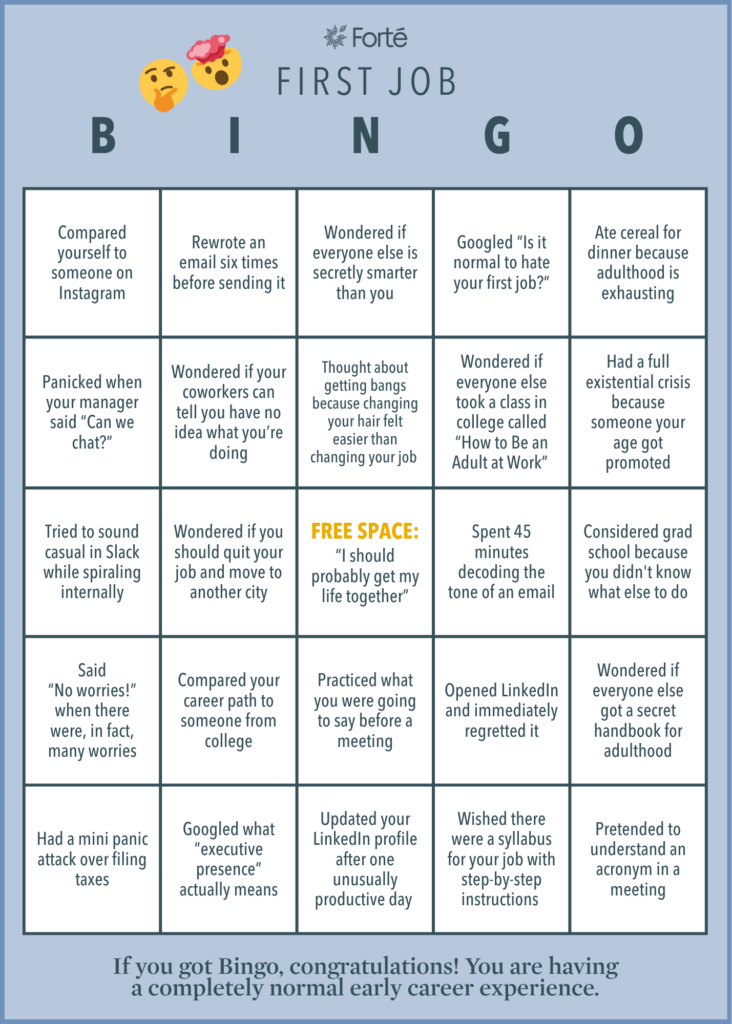
If this blog hit a little too close to home, you’ll love our First Job Bingo Card.
See how many squares you’ve lived through and share it with your friends who may also be quietly spiraling.
Because if you got Bingo, congratulations: you’re having a completely normal early‑career experience.