Employers are remarkably consistent about the skills they want most.
In a recent survey of Forté member companies, employers said they are looking for communication, analytical thinking, coachability, professionalism, leadership, client-facing confidence, and the ability to work well with others. They want people who can stay calm under pressure, build trust quickly, navigate change, and help teams move work forward.
That aligns closely with what broader workforce research is finding as well.

even in an AI-driven workplace, someone still has to manage the personalities, the ambiguity, and the meeting that has somehow drifted 20 minutes off topic."
LinkedIn’s 2025 Skills on the Rise report found that while AI literacy was the fastest-growing skill, it was not defined as coding or building models. Instead, it reflected the ability to use AI strategically to solve problems, make decisions, and improve work. Beyond AI literacy, 10 of the 15 fastest-growing skills were human skills like adaptability, conflict mitigation, public speaking, innovative thinking, stakeholder management, customer engagement, and risk assessment. In other words, even in an AI-heavy workplace, employers are still placing enormous value on the things humans do best.
Apparently, even in an AI-driven workplace, someone still has to manage the personalities, the ambiguity, and the meeting that has somehow drifted 20 minutes off topic.
And here’s what makes this more than just one more article about leadership: many of the skills employers value most are the same ones women already bring to the table.
In a 2019 Harvard Business Review article, leadership researchers Jack Zenger and Joseph Folkman reported that women outperformed men in 13 of 16 leadership competencies, including taking initiative, resilience, relationship-building, developing others, integrity, and problem-solving. Look familiar? These are many of the same skills employers now say they value most.
Another large meta-analysis by Samantha Paustian-Underdahl and colleagues, which examined 99 different studies, found that women were generally rated as equally or more effective leaders than men by others. Men, however, tended to rate themselves more highly.
Imagine that 🙂
That gap may help explain why so many women still feel as though they need to develop leadership skills they already use every day. Many of the skills women are strongest in don’t always sound like ‘leadership’ when women describe them.
Women are often more likely to talk about supporting the team, keeping people informed, helping others succeed, smoothing over conflict, or stepping in where needed. They may describe themselves as organized, dependable, collaborative, or good with people.
Organizations, meanwhile, tend to describe those same behaviors very differently.
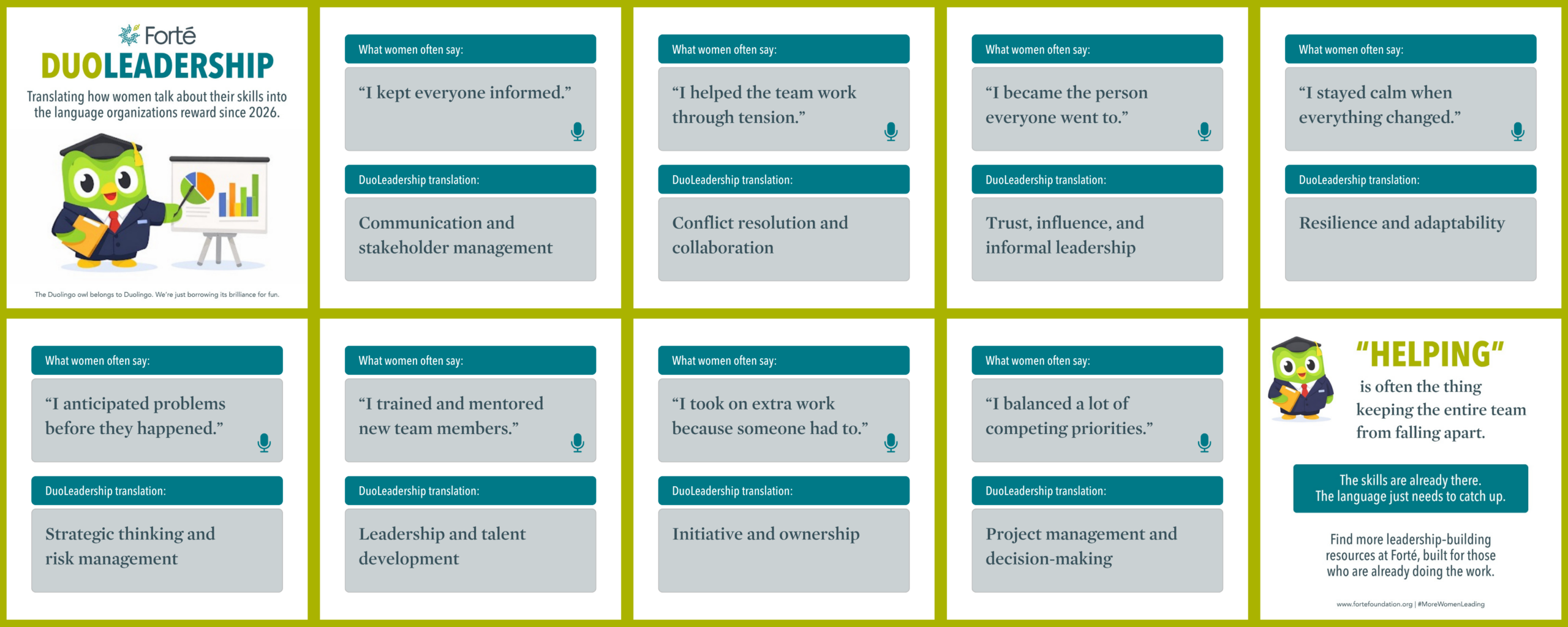
| What Women Often Describe | What Employers Actually See Value In |
| Keeping everyone informed | Communication and stakeholder management |
| Helping a team work through conflict | Collaboration and conflict navigation |
| Being the person others go to for help | Trust, influence, and informal leadership |
| Staying calm when things change | Resilience and adaptability |
| Anticipating problems before they happen | Strategic thinking and risk management |
| Training or mentoring others | Developing talent and leadership potential |
| Taking on extra work to help the team | Initiative and ownership |
| Balancing multiple priorities | Project management and decision-making |
In other words, women are often already doing the work of leadership, even if they are not always calling it that.
[Many women] need to get more comfortable describing the skills they already have in the language organizations reward."
Same skills. Different words.
As work becomes more complex, distributed, and AI-driven, these human skills are becoming more valuable, not less. Communication, adaptability, conflict navigation, judgment, and the ability to build trust are not “nice to have” skills. They are increasingly the skills that help teams function and leaders stand out.
Women don’t need to develop a whole new set of leadership skills. But many do need to get more comfortable describing the skills they already have in the language organizations reward.
- Because “helping” is often the work that keeps everything moving.
- “Being organized” is often project management.
- “Keeping everyone informed” is often stakeholder management.
- “Being the person everyone goes to” is often influence.
- “Stepping in when things get messy” is often leadership.
The skills are already there. The language just needs to catch up.