
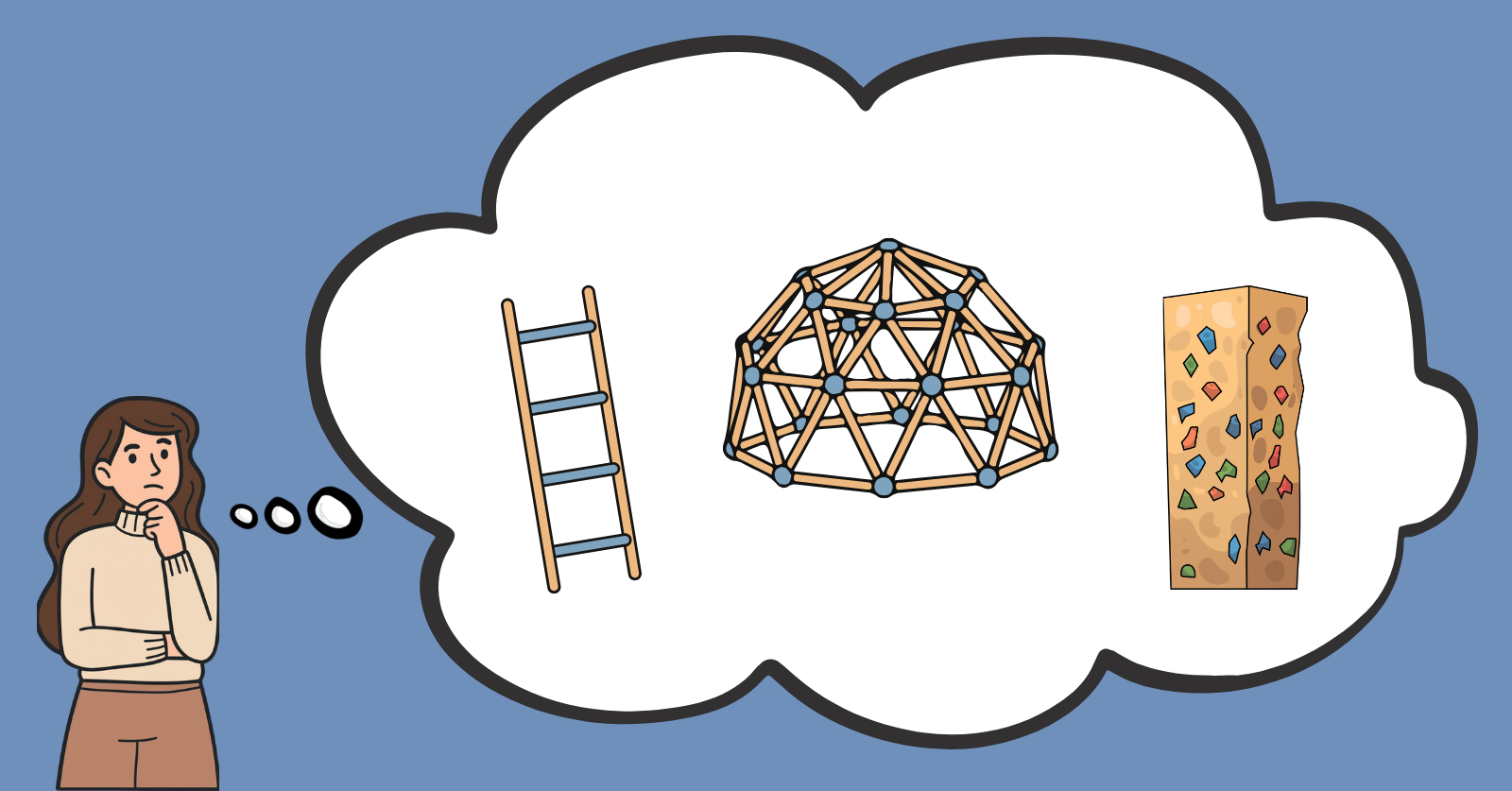
A colleague of mine said something the other day that I haven't been able to stop thinking about.
We were talking about career ladders, the metaphor, the model, the whole idea, and she paused and said: Why did we all assume the ladder went up?
I mean, what are ladders for, other than to get to a level you can't reach without one?
But for careers, a lot of smart people already know the ladder isn't quite right. Dr. Wanda Wallace, whose work I admire, writes about career paths as a tree. Others have proposed jungle gyms, lattices, and climbing walls. These metaphors are more accurate. Some of them are genuinely useful.
And yet here we are. Still talking about rungs.
A lot of people talk about the ladder being broken. My question is why it keeps winning.
Part of the answer is that the ladder isn't just a shape. It's a system. The glass ceiling only makes sense if there's a ladder underneath it. The broken rung only matters if you were supposed to be climbing. The leaky pipeline assumes there's somewhere up the pipe to go. Replace the ladder with a jungle gym and you don't just lose the metaphor. You lose the entire vocabulary that lets people name what's unfair. That's a surprisingly high price for accuracy.
There's also something about legibility. "Where are you on the jungle gym?" doesn't work the way "what's your next rung?" does. The ladder gives everyone the same map. Even a wrong map, it turns out, is easier to use than a better one that's harder to read.
And part of me wonders if the people most invested in the ladder tend to be the people least motivated to swap it for something else.
So the ladder survives. Not because it is completely accurate, but because it's useful. Neat. Shared. And right-ish enough to keep the conversation organized, even when the conversation is about why it fails.

The ladder gives everyone the same map. Even a wrong map, it turns out, is easier to use than a better one that's harder to read.”
But my colleague's question is still rattling around in my head.
The ladder pointed up when the ladder was load-bearing. But is it still?
What I keep noticing is that the people who are actually moving forward in organizations aren't following a ladder. They're following something harder to name and harder to draw on a slide. Proximity to a problem that mattered. A relationship that opened a door. A moment when someone's name came up in a room they weren't in, and what was said about them made all the difference.
Those aren't rungs. They're signals. And the reason the ladder metaphor can't capture them isn't that it's outdated. It's that it was always looking at the wrong thing. It tracked the structure. Signals live in the space between the rungs.
ASK YOURSELF
Think of someone in your organization who has advanced recently. Did they climb the ladder, waiting for a rung to open, moving straight up? Or did something else explain it: a relationship, a moment, a project that put them in front of the right people at the right time?
If it was the second thing, you already understand more about how the system actually works than the ladder could ever explain. And possibly more than the ladder wanted you to.